Guide to Jefferson County Clerk’s Office Records

Guide to Jefferson County Clerk’s Office Records

This guide provides instructions on how to access Jefferson County, Kentucky, Clerk’s Office (JCCO) records on FamilySearch, as well as information about the different types of records and the history of the JCCO.  

Copies of JCCO records can be accessed in person at the JCCO Deed Room, with copies of many of these records also available at other repositories.  

Contents

JCCO Records on FamilySearch

How to Search Jefferson County Records on FamilySearch

County Court Minute and Order Books

Marriage and Divorce Records

Wills and Probate Records

Deeds

Tax Records

Circuit Court Case Files

Repositories for JCCO Records

History of the Kentucky County Courts and JCCO

JCCO Records on FamilySearch

FamilySearch is a database providing access to genealogy and historical records, including land, census, immigration, marriage, birth, death, church, and orphanage records. FamilySearch partners with archives around the world to digitize records and host them online. Access is free but requires the researcher to create an account. You can register at this link: https://www.familysearch.org/en/register/. 

The following books and groups of Jefferson County Court and Circuit Court records before 1865 (with most continuing into the late 1800s-1900s) have been digitized and are available on FamilySearch. See the headings and sections below for information about each record group. Documentation of many types of records, such as wills, deeds, and estate papers, may be referenced and found in multiple record groups/books. 

How to Search Jefferson County Records on FamilySearch

Many of the Jefferson County records on FamilySearch have not been indexed and cannot be located using the standard Records or Ancestor search functions. They can only be found using the Catalog, Images, or Full-Text search functions. Be aware that the Full-Text search uses AI-generated transcriptions, which often contain errors. 

Searching Specific Record Groups 

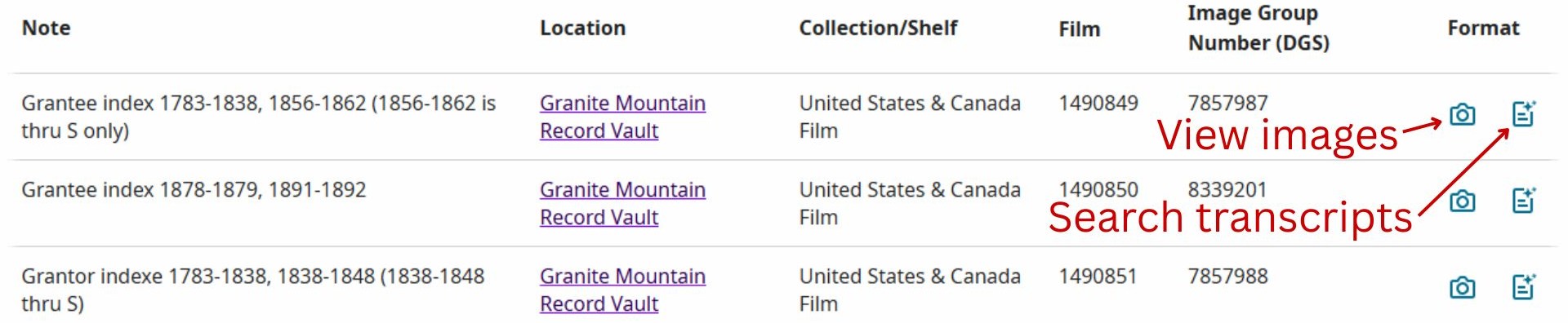
Once you have signed in to your FamilySearch account, the links listed in each record group below will take you directly to the catalog pages for the records. Scroll down the page and click on the camera icon in the right-hand column to view and browse images of the records. Click on the document icon to search for a name, word, or phrase within the AI-generated transcripts for that group of images. Abbreviations are often used in Jefferson County records to identify “people of color” (PC), “free man of color” (FMC), “free woman of color” (FWC), etc. 

Screenshot of sample FamilySearch catalog

Screenshot of sample FamilySearch catalog

Searching across Multiple Record Groups 

FamilySearch’s Full-Text Search searches across all records in FamilySearch. To find JCCO records specifically, you’ll need to apply filters after your initial search to narrow the results. 

Once you have signed in to your FamilySearch account, click Search in the top menu bar. From the drop-down list, select Full-Text. Enter a name, word, or phrase in the search box and click Search. 

Applying Filters 

Use the filters panel on the left side of the results page to focus on Jefferson County records. Multiple filters can be combined for more precise results. 

Place Filter: Click the down arrow to expand Place, then expand United States of America and Kentucky. Check the checkbox next to Jefferson and click the blue Apply button. 

Year Filter: Click the down arrow to expand Year, then expand 1700 AD and/or 1800 AD depending on your target period. Check the checkboxes for the decades you want to search and click the blue Apply button. 

Note: These results may still include some non-JCCO records that match your filters.

Click here to return to the table of contents

County Court Minute and Order Books

Click the FamilySearch links below to access digitized images of: 

Minute-Order Books, 1780-1793, 1796-1901, Depositions in Land Cases, 1795-1829 

These records include: 

  • Transcriptions of Minute-Order Books A, 1-3 (1780-1793)
  • Transcriptions of depositions taken in County Court land cases (1795-1829), not indexed; in the title image, this set of records is erroneously labeled as Minute Book 4
  • Transcriptions of Minute-Order Books 5-12 (1796-1821)
  • Minute-Order Books 12-60 (1817-1901)
  • Most of the books are indexed, either at the beginning or the end of each book

Minute-Order Books, 1784-1785, 1790-1793, Depositions in Land Cases, 1795-1829

These records include:

  • Minute-Order Books no. 1 (1784-1785) and no. 3 (1790-1793), index at end of each book
  • Depositions taken in County Court land cases (1795-1829), not indexed

Order Book, 1784-1785

  • This Order Book provides more extensive information than the Minute-Order Books about legal cases that came before the County Court, but it does not record testimony or evidence, and it is not indexed

About the County Court Minute and Order Books: 

The Jefferson County Court Minute and Order Books are important sources of local history. As chronological logs of the administrative, financial, and judicial proceedings of the County Court, they provide considerable information about the county and local residents.   

Minutes are the County Clerk’s daily record of the County Court’s proceedings. Minute Books (also called Minute-Order Books since they often include a mix of minutes and a record of orders) contain brief summaries of the legal, administrative, and financial matters that came before the Court, as well as the orders issued by the Court. Orders are the Court’s final and official rulings on legal, administrative, and financial matters. The County Clerk typically would transfer information from the Minute Book into the appropriate Order Book or Deed Book, writing in more formal legal language. For example, when legal instruments such as deeds were produced in Court and proven by witnesses, the Court issued an order for the document to be recorded, authorizing the Clerk to copy the full text into the official Deed Book.  

Minute and Order Books can include documentation of the following: 

  • Appointment of local officials.
  • Tavern licenses.
  • Construction and maintenance of roads, bridges, mills, dams, and ferries, as well as appointments of road overseers’ committees to determine road sites, mill sites, and the location of public buildings.
  • Bonds. A written legal promise stating that an individual (and their co-signers or “sureties”) would pay a severe financial penalty to the County Court if they failed to perform a specific legal, civic, or moral duty. The different types of bonds include bastardy bonds (a guarantee from the person identified as the father to financially support a child born to unmarried parents), apprentice bonds (a guarantee from a person to teach an apprentice, often one who was orphaned, a specific trade), and ordinary bonds (a guarantee from tavern owners or innkeepers that their businesses would adhere to legal and moral standards).
  • Indentures of apprenticeship. An agreement binding an apprentice (often an orphaned child or a free Black child) to learn a specific trade or craft for a set number of years. The indentures of apprenticeship contain the name of the person or institution binding out, the person to whom bound, the name of the person being indentured, the length of the apprenticeship, and the responsibilities of the person taking on the indenture.
  • Orphan guardianships and guardian bonds. After the death of a father or both parents, the Court would appoint a guardian for minors. Guardians were required to sign a bond guaranteeing they would perform their duties and deliver the remaining inheritance when the minor came of age.
  • Land deeds. Deeds were either acknowledged in open court by the maker or were proved by witnesses. In the latter case, the general rule for deeds conveying land was that two witnesses had to swear in court that they saw the grantor sign the document before it would be ordered to be recorded. See also: Deeds
  • Deeds of emancipation (“free papers”). The County Court presided over the legal emancipation of enslaved individuals. Enslavers could emancipate enslaved people by one of two methods: a document executed before the court or a provision in a will. Courts recorded the means of emancipation and issued decrees of freedom to the formerly enslaved individuals. Executors or heirs sometimes challenged the validity of emancipation in a proceeding in Circuit Court. See also: Deeds
  • Wills or estate administration information. Where there was no will and no named executor, the Order Book recorded the appointment of administrator for the estate of the deceased. Most of the judicial business of the County Court involved probating wills and overseeing the administration of estates. Wills before 1865 include those made by free Black individuals and wills made by enslavers that list enslaved individuals. See also: Wills and Probate Records
  • Lunacy inquests. These proceedings determined whether a person was—in the language of the late 1700s and 1800s—a “lunatic” (a person legally declared to be of unsound mind) or an “idiot” (a person legally declared to be lacking in mental understanding).
  • Legal suits. Order books recorded the disposition, or final decisions, of small claims cases and misdemeanors. These legal suits provide a picture of the family and financial relationships among county residents, including free and enslaved Black individuals.

Click here to return to the table of contents.
Marriage and Divorce Records

Click the FamilySearch links below to access digitized images of: 

Marriage Index and Registers, 1784-1911 

Marriage Records, 1781-1951 

  • These records include marriage bonds, certificates, and licenses.  

Marriage Records, 1852-1931 

  • These records are marriage bonds only. Beginning in 1916, some of the records include certificates.  

Marriage records consist of the following types of documents filed separately with the County Clerk: 

  • Marriage bonds. Bonds were given to the court by the prospective groom prior to the marriage. A bond includes the names of the prospective groom and a bondsman, the name of the prospective bride, date the bond was posted, and a signed pledge stating there were no moral or legal reasons why the couple could not be married. It also affirms that the groom would not change his mind. If he did, and did not marry the intended bride, he would forfeit the bond. The bondsman, or surety, was typically a family member of the groom, but could also be a neighbor or friend. Marriage bonds can include information about whether the marriage-to-be is the first, second, third, etc., marriage, and if an individual is widowed or divorced. Bonds were typically filed in the bride’s county of residence. The marriage usually took place a day or two after the date on the bond. A marriage bond shows an intent to marry and a guarantee that it was legal; it does not prove the marriage took place. 
  • Marriage licenses and certificates. These were issued by the County Clerk of the county in which the woman resided. Consent of legal guardians was required for either party under 21 years. Licenses and certificates usually provide information about the couple getting married, including age, previous number of marriages, the place of marriage, and the person who married them. The issuance of a license does not serve as evidence that the marriage took place. The marriage certificate does provide evidence of a marriage, as it is completed after the marriage by the minister or judge. 
  • Marriage registers. Registers include the date of the marriage license and the names of the couple. In the first half of the 1800s, registers also often include a column for remarks or notes, the name of the person who married them, the date of the marriage, the place of the marriage, and names of witnesses. 

About divorce records:  

Prior to 1809, a divorce in Kentucky could only be granted by the Kentucky General Assembly. Circuit Courts were established in 1802 but were not given authority to rule on divorce petitions until 1809. Divorces would continue to be granted by legislative act until 1849 when the state’s third constitution was created. The new constitution prohibited the legislative body from issuing such special acts. Between 1809 and 1849, references to divorces might be found in court records (in Jefferson County, either the Chancery division of the Jefferson Circuit Court or the Louisville Chancery Court) and/or among the Acts of the General Assembly. After 1850 divorce cases were limited to the Circuit Courts, which ruled on them as civil cases. 

Click here to return to the table of contents.

Wills and Probate Records

Click the FamilySearch links below to access digitized images of: 

Will Books, 1784-1833 

Wills, 1784-1901; Index, 1784-1919 

General Index to Inventories and Settlements,1800-1910 

Property Settlement Books, 1800-1910 

  • Click on the Image Group Number to access digital images of the records. You can first use the General Index to Inventories and Settlements to find named individuals, usually the deceased or the executor, and then locate the corresponding Image Group at this link.  

Index; Plat Records, ca. 1852-1950; Division Books, ca. 1797-1950 

  • These records document the division and distribution of deceased people’s land and personal property, including enslaved individuals, by commissioners appointed by the County Court 

Index and Case Files, Division of Land Suits, ca. 1852-1950 

Estate and probate records can include the following information and documents, often filed in separate books:

  • Last will and testament. Disposes an individual’s property upon death according to the individual’s wishes. Will books may include estate records other than just wills. Wills before 1865 include those made by free Black individuals and wills made by enslavers that list enslaved individuals.
  • Letters of administration. In cases of intestate estates (an estate of a deceased person with no will and no named executor), letters of administration are requested to grant an administrator (usually the widow/widower or eldest son) the right to oversee the distribution of the estate in accordance with prevailing laws.
  • Inventory. Lists all personal and real property assets of the deceased at the time of death, including furniture, farming equipment, and enslaved people (with names, ages, and information about relationships).
  • Appraisement. Establishes the value of the inventory. If an inventory included enslaved individuals, they were assigned a dollar amount.
  • Estate settlement. Involves settling the financial matters of the deceased (also called the decedent) by collecting assets, paying debts, and distributing the remaining assets according to the terms of the will or according to the laws of descent that applies when there is no will. The final settlement document closes out the estate of the deceased.
  • Guardian settlement. The County Court usually appointed a male guardian for underage children, even if just the father had died and the mother was still alive. The Court took bond from the appointed guardian as security, and required the appointee to make periodic accountings of receipts and expenditures.
  • Sale bills. Shows what was sold at the estate sale, the purchaser, and the amount paid.
  • Dower. The portion of an estate that a widow is entitled to for her lifetime upon the death of her husband. The portion was traditionally 1/3 of the estate, though this varied by area and time period.
  • Affidavit of Descent. A document that proves that a person was the legal heir of the deceased.
  • Commissioners’ Reports and Deeds. The County Court appointed commissioners to settle disputes (usually estate settlement disputes) involving the division of real property and personal property, including enslaved individuals. These reports and deeds often mention all heirs. If an heir has passed away and has children, they are often mentioned as well, since they are entitled to their parent’s share of the estate.
  • Plats. A scale drawing of a piece of land subdivided into lots; often included in commissioners’ reports.

Click here to return to the table of contents.

Deeds

Click the FamilySearch links below to access digitized images of: 

  • County Court Deeds, 1783-1911
    These records include Grantee Indexes, Grantor Indexes, and Deed Books. A Grantor is the person selling or transferring property; a Grantee is the person buying or receiving property.
  • Circuit Court Commissioner’s Deeds, 1812-1847
    These specialized deeds occurred when the Jefferson County Circuit Court stepped into property cases due to legal disputes, debt, delinquent taxes, or unresolved estates, ordering the commissioner to forcibly transfer land ownership to resolve the case.
  • Chancery Court Commissioner’s Deeds, 1835-1871
    These specialized deeds occurred when the Jefferson County Chancery Court (established in 1835 to take over property and equity/chancery cases) stepped into property cases due to legal disputes, debt, delinquent taxes, or unresolved estates, ordering the commissioner to forcibly transfer land ownership to resolve the case.

About deeds and deed books: 

A deed is a document to convey, sell, transfer, or release ownership of real property (for example, land) or personal property (for example, enslaved individuals, furniture, or farm equipment) through purchase, gift, or inheritance. These records typically include the following information: dates; the names of Grantor (person selling or transferring property) and Grantee (person buying or receiving property); a description of the assets or the enslaved person being deeded; signatures; and the certification of the County Clerk, including the date and clerk’s signature.  

When a person brought an original deed to the County Clerk’s office, the Clerk transcribed the text of the deed into a sequence of Deed Books. The Clerk then filed it in the general land index and returned the original physical deed back to the buyer or owner. The certification by the county could occur years or decades after the deed was signed by the Grantor and Grantee.  

In the late 1700s and early 1800s, when specially designated record books did not exist, the County Clerk often copied a wide range of legal transactions into Deed Books. 

Deed books can include the following types of information and documents: 

  • Surveys. A written and visual description of the land by measuring and naming boundary features. It was a prerequisite for a land grant patent, which was issued by the state and transferred ownership of the land from the government to the individual.  
  • Plats. A scale drawing of a piece of land subdivided into lots.  
  • Warranty deed. A legal instrument containing title covenants, meaning the seller (grantor) promises that they hold a clear, valid title to the land and will protect the buyer (grantee) against any prior claims, liens, or encumbrances. 
  • Indenture. An indenture is a legal contract between two parties that outlines the obligations of each, particularly for indentured labor or a term of apprenticeship but also for certain land transactions.  
  • Mortgage. Financial agreement pledging land or property as collateral for loans. Enslaved people were sometimes used as collateral. 
  • “Slave deeds,” also known as “bills of sale” or “slave bills of sale.” A contractual sale receipt between an enslaver and a buyer for the purchase of an enslaved person or people. These are property deeds registered with the County Court. Sometimes these individuals are listed only by number, but more often they are listed by name and age, providing valuable historical information for historians and genealogists. 
  • Power of Attorney. An instrument that appoints someone else to follow through on a legal situation. This is often used if an individual has moved away and can give information on the location of other heirs. 
  • Commissioners’ Deeds. The County Court appointed commissioners to settle disputes (usually estate settlement disputes) involving the division of land and personal property, including enslaved individuals. These deeds often mention all heirs. If an heir has passed away and has children, they are often mentioned as well, since they are entitled to their parent’s share of the estate.  

Click here to return to the table of contents.

Tax Records

Click the FamilySearch links below to access digitized images of:

Jefferson County Tax Assessor, Tax Books, 1789-1892

About tax books:
Tax commissioners or assessors were appointed by the County Court to compile alphabetical tax lists of the names of taxpayers (the head of the household or property owner, some of whom were free Black men and women and White women), land acreage, and property values, which were submitted to the County Clerk and certified.

Tax books often include the following columns, which were filled with the number of each:

  • White Males over 21: Free white males in the household over the age of 21; they were subject to the county levy.
  • Blacks/Slaves: Typically split into multiple columns to assess value, such as “Blacks under 16” and “Total Blacks.”
  • Horses, Mares, Mules, and Colts: A count of equine property. Owning a single horse was enough to land someone on the tax roll, making these lists an annual census surrogate.
  • Cattle: A count of the taxpayer’s cattle.
  • Land Columns (if land was owned):
    • Acres of Land: The total acreage being claimed or owned.
    • County: The county where the land was physically located (if different from Jefferson County).
    • Watercourse: The nearest river, creek, or water source, which was used to geographically identify the land before structural grid systems existed.
  • Luxury and Commerce Columns:
    • Carriages / Wheels: The number of riding carriages or wheels (a major luxury tax at the time).
    • Billiard Tables: Regulated and heavily taxed entertainment items.
    • Ordinary Licenses: A column indicating if the individual holds a license to operate a tavern or inn.
    • Retail Stores: A column indicating commercial merchant shops.

Click here to return to the table of contents.

Circuit Court Case Files

Click the FamilySearch links below to access digitized images of: 

Common Law Case Files, 1783-1822  

  • These records encompass law case papers from the Jefferson County Court (1783-1785), the Jefferson County Court of Quarter-Sessions (1785-1802), and the Jefferson Circuit Court (established in 1802). Common law cases were ones seeking monetary damages.  

Click here to return to the table of contents.

Repositories for JCCO Records

Copies of JCCO records can be accessed in person at the JCCO Deed Room, with copies of many of these records also available at other repositories. Click on the links below for information and additional links about these institutions’ hours of operation, possible research fees, and records holdings. 

Jefferson County Clerk’s Office Deed Room 

Louisville Metro Archives 

Kentucky Department for Libraries and Archives 

Filson Historical Society 

Click here to return to the table of contents.

History of the Kentucky County Courts and JCCO

Jefferson County was established in 1780 when Kentucky County, Virginia, was subdivided into Fayette, Lincoln, and Jefferson counties. At this time, a monthly County Court served as the sole government body for each county. It also heard all cases except for criminal cases in which conviction would result in the loss of life or limb. In 1785, a newly formed Court of Quarter-Sessions for each county assumed jurisdiction over serious civil and criminal cases, and the County Court was designated as a court of record for administrative and financial matters. The County Court also had jurisdiction over civil matters not vested in the Courts of Quarter-Sessions, especially cases concerning wills, probate issues, and guardianship. 

In the decades after Kentucky became a state in 1792, the business of the Jefferson County Court involved executive, legislative, and judicial functions that brought it into contact with hundreds of local residents each month. The Jefferson County Court was made up of nine Justices of the Peace, with the number increasing in future years. From 1800 to 1850, the Justices of the Peace were appointed positions that required no legal training. The County Court in these years had jurisdiction over probate court, orphans and apprentices, and bastardy cases. It examined and admitted deeds and other documents to record, administered poor laws, established ferries and roads, oversaw ferry rates and road maintenance, collected both county and state taxes, and settled minor civil or criminal issues, among other responsibilities. 

In 1801-1802, the Kentucky General Assembly created a system of Circuit Courts, phasing out the Court of Quarter-Sessions. In Jefferson County, this newly created court was called the Jefferson Circuit Court. It continued the dockets of the former Court of Quarter-Sessions and District Court: ordinary (common law) for cases seeking monetary damages; and equity (chancery) for cases requiring non-monetary, fairness-based remedies.  

In Jefferson County, from the early 1800s through 1838, the same person served as Clerk for both the County Court and the Circuit Court. After the resignation of Stephen Ormsby from the County Court Clerk position in 1796, Worden Pope was appointed to replace him. Pope was also appointed Circuit Court Clerk in 1803. He resigned as Circuit Court Clerk in 1834 and was succeeded by one of his sons, Edmund Pendleton Pope. After Worden Pope’s death in 1838, another son, Curran Pope, succeeded him as County Court Clerk.  

The Jefferson County Clerk recorded and maintained court minutes and orders, deeds, land entry surveys, marriage bonds and licenses, guardianship bonds, wills, settlement books, estate inventories, and tax lists, among other documents. These local records serve as valuable resources for genealogical and historical research today.  

The Louisville Chancery Court was established in 1835, and it assumed the equitable and chancery jurisdiction previously held by the Jefferson Circuit Court. In 1865, the Jefferson Court of Common Pleas became a separate and distinct court for common law, and the Jefferson Circuit Court primarily had jurisdiction over criminal cases.  

In 1850, Kentucky’s third constitution made several changes to the organization of the county court system and county government. Almost all county positions were made elective, decided by popular vote. Each county was divided into districts, each with a Justice of the Peace, and the County Judge position was created to oversee the entire county. The County Judge took over most responsibilities from the Justices of the Peace, probating wills, hearing petty civil and criminal cases, and supervising the judicial business of the County Court. Justices kept a more limited position, usually on the court of claims, setting local taxes, paying any county bills, and supervising construction and maintenance of roads and public buildings.  

Sources: 

Click here to return to the table of contents.